Outside an aircraft window, clouds lie below and the sky is darker above. We are already very high. But satellites are higher still, and a tourist rocket can briefly lift someone “into space.” How far upward must we travel for the journey to count as spaceflight?
The short answer: 100 km is a commonly used marker, but there is no wall there and no point where the air suddenly ends. And reaching orbit requires much more than altitude alone.
Follow the main thread. Optional branches add details and a calculation; you can skip them and continue with the next main section.
A boundary agreed by convention
Earth is already part of the Universe: space does not begin beyond some roof over our planet. When we speak of flying “into space,” we need a practical way to distinguish it from ordinary atmospheric flight.
The Fédération Aéronautique Internationale, FAI, uses 100 km to separate aviation and space records. This altitude marker is called the Kármán line. It is a convention, not a surface discovered in nature. The FAI technical overview, slide 2 explains this directly.
Imagine a “city begins here” sign. It helps us name places, but the road at the sign does not turn into a different material. Likewise, an altitude boundary helps classify a flight. The analogy explains the convention; it does not describe the atmosphere’s physical structure.
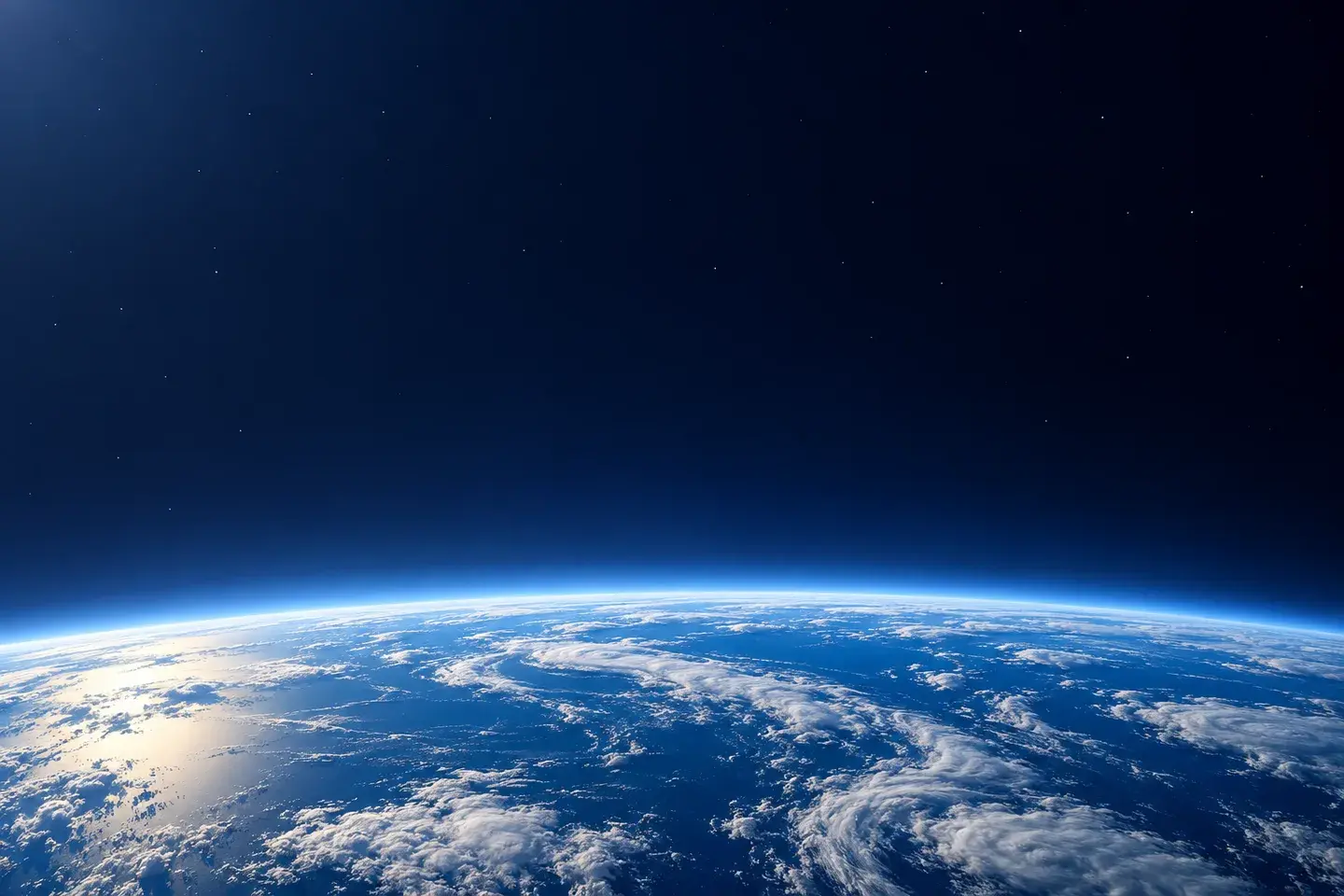
The atmosphere, the gas surrounding Earth, gradually becomes less dense. Its outer regions extend far above 100 km. A craft can therefore be “in space” under the chosen definition while still encountering atmospheric particles. NASA on atmospheric layers.
Above EarthAltitude guide · not to scale
- 450–490 kmStarlinkBroadband shells in the 2026 plan*
- ≈400 kmInternational Space StationA guide, not its current altitude
- >100 kmNew ShepardSuborbital flight above the boundary
- 100 kmKármán lineA convention, not the edge of the air
- ≈11 kmPassenger aircraftAn example cruising altitude
Earth’s surface · 0 km
From aircraft to satellites: how high is each?
For a passenger jet, about 11 km is a useful guide. NASA, for example, gives 35,000 feet, or approximately 10.7 km, as an airliner altitude. It is an example cruising altitude, not the altitude of every flight. NASA on airborne atmospheric observations.
Almost another 90 km separates an ordinary airliner from the Kármán line. Satellites do not form a single “ceiling” above it: they use different orbits for different tasks.
| Reference | Height above Earth’s surface |
|---|---|
| Passenger aircraft | About 11 km as an example |
| Kármán line | 100 km: a conventional boundary |
| International Space Station, ISS | About 400 km; altitude varies |
| Low Earth orbit | Usually from about 180 km to below 2,000 km |
| Geostationary satellites | About 35,786 km above the equator |
NASA describes the ISS orbit as 370–460 km. Residual air slows the station, so engines periodically raise its orbit. This illustrates why being in space does not imply a complete absence of atmosphere. NASA’s ISS overview, Assembly section.
A geostationary satellite moves around Earth so that it remains above the same equatorial location. Such orbits are useful for communications and weather observations. They are far beyond the ISS and low-orbit constellations. The lower limit of low Earth orbit depends on atmospheric drag; 180 km here is a guide, not a physical prohibition on flying lower. ESA on orbit types.
Did Blue Origin reach space, or only nearly?
Blue Origin’s New Shepard has crossed the Kármán line. Its first flight carrying people took place on 20 July 2021; the company confirmed crossing that boundary. Blue Origin’s first human flight report.
The important distinction is between suborbital flight and orbital flight. New Shepard lifts its capsule above the boundary and returns it to Earth. It does not place its passengers in orbit around the planet. New Shepard’s flight and return.
SpaceX’s Crew Dragon performs a different task. For example, Demo-2 launched on 30 May 2020, docked with the ISS the next day, and its crew spent 64 days in space. This was an orbital flight, not a brief ascent and descent. NASA’s Demo-2 summary.
Reaching orbit means not just climbing, but gaining enough speed along Earth’s surface. Imagine a ball thrown sideways: it falls, but at a very high speed the planet’s surface “curves away” underneath it. This offers an intuition for orbital falling; we temporarily ignore atmospheric drag in the analogy. ESA on reaching orbit.
Thus “crossed the space boundary” and “reached orbit” are different achievements. Compare specific craft and missions here, rather than all rockets belonging to the two companies.
Returning to the main idea
When someone says “we flew into space,” you can now ask three things: which boundary they crossed, what altitude they reached and whether they entered orbit. An aircraft’s height, a tourist capsule’s ascent and a satellite’s orbit describe different ways of moving above Earth.
The 100 km line is useful as a convention. Air gradually thins, gravity continues to act, and satellites need more than altitude. Space becomes easier to understand when we distinguish names from physics.